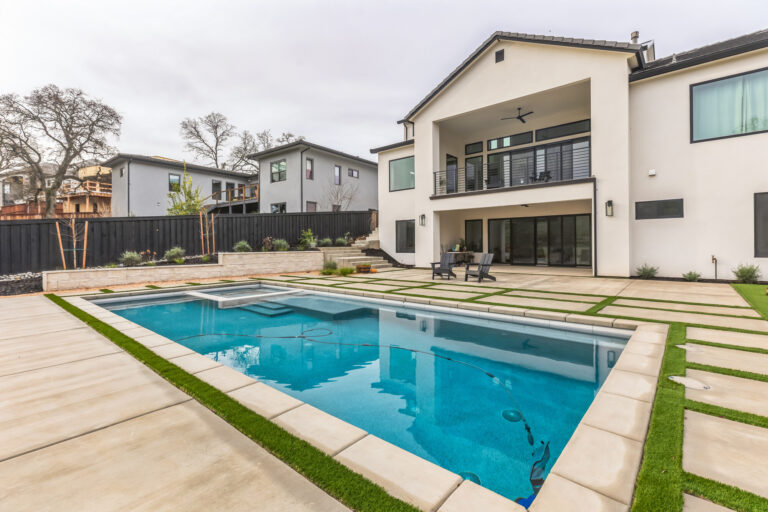
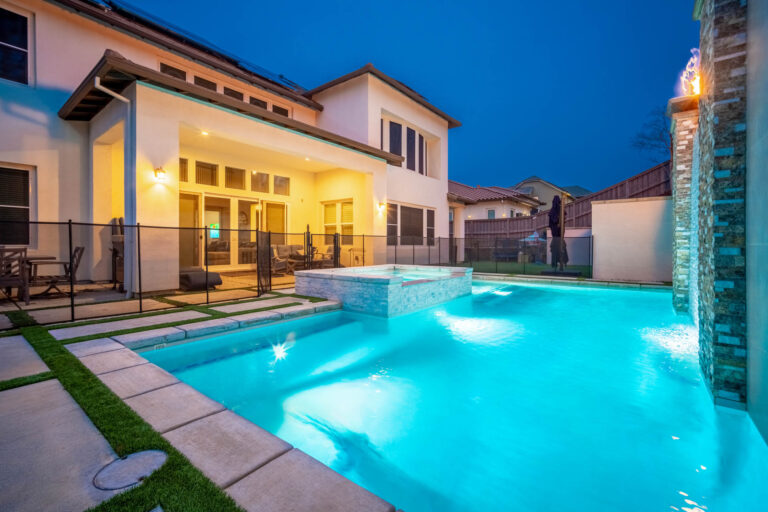
Most Sacramento homeowners run into the same question early in the planning: should the backyard get a gunite pool, a fiberglass pool or an above ground pool? All three hold water, but they behave very differently once you have owned them for ten summers.
The right pick usually comes down to your lot and how long you plan to stay in the home, so below we walk through how each type is built, where each one makes sense, and what changes after the water goes in.
What a Gunite Pool Is and How It Gets Built
A gunite pool is a concrete pool formed on site rather than delivered in one piece. After the crew excavates the shape and runs the rough plumbing and electrical lines, a grid of steel rebar is tied through the entire shell. A dry concrete mix is then sprayed through a hose at high pressure, with water added at the nozzle, so it bonds to the rebar as it lands.
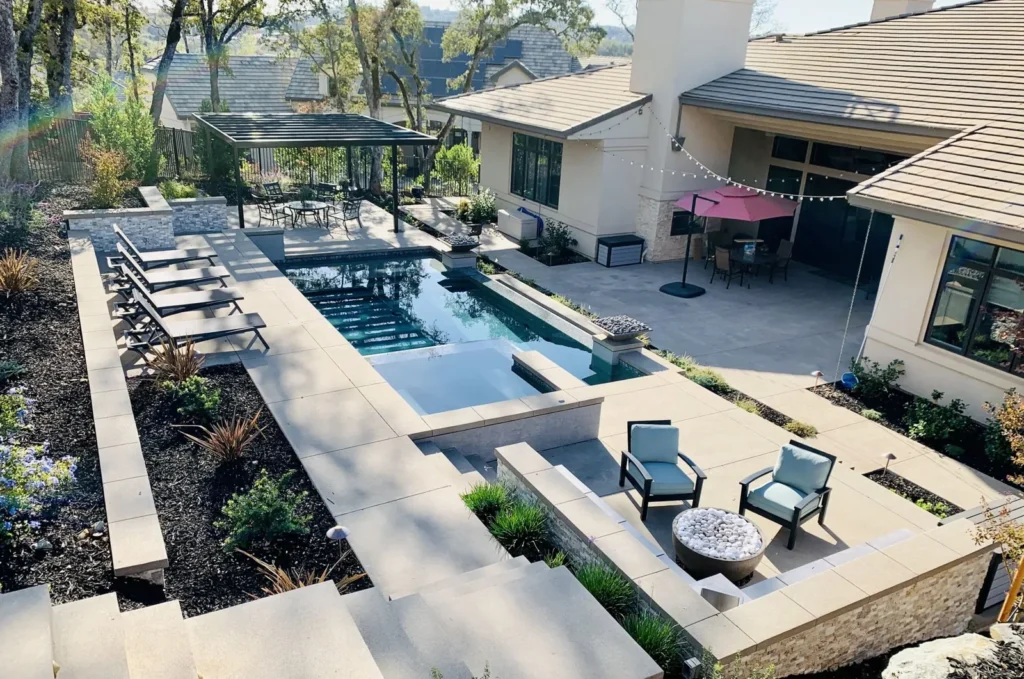
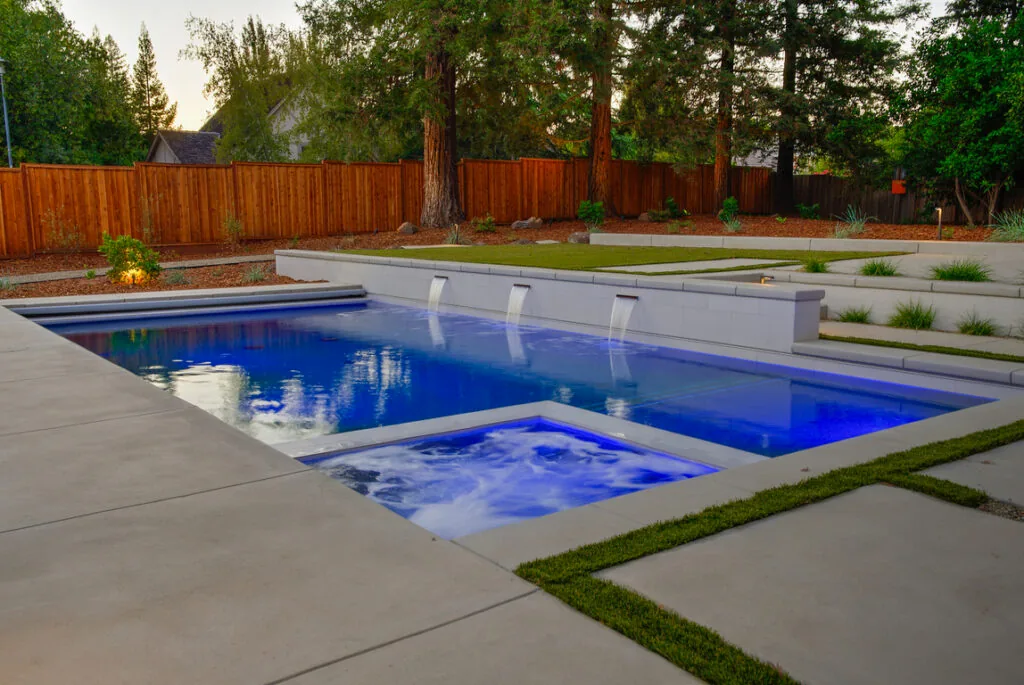
Because there is no factory mold involved, the design sets the depth and the outline of the pool. That also means a spa can be built into the same structure, along with features like a tanning ledge or a raised wall that spills into the pool.
Inspections happen at set stages along the way. On our builds, the first inspection follows the rebar and rough plumbing, before any gunite is sprayed. That order matters, since the steel inside the shell is what gives a gunite pool its strength over decades.
Over time, the interior surface is the part that wears. Plaster is the traditional finish, while pebble and other aggregate finishes usually last noticeably longer, often close to twice as long with good water care. When a finish does wear out, the shell underneath stays where it is, which is why a gunite pool can be resurfaced or fully renovated many times over its life.
How a Fiberglass Pool Differs
A fiberglass pool arrives as a single shell made in a factory. The crew digs a hole to match it, sets a base, lowers the shell in by crane and then backfills around it. Its gelcoat surface is smooth and soft underfoot, and it gives algae less to grip than a textured finish.
The tradeoff is the mold itself. You choose from the shapes a manufacturer already produces, and because shells travel by truck, their width is capped by what can legally move on a highway. Long, narrow lap pools suit that format well, but wide freeform designs and spas built into a specific corner usually do not.
Access is the other big question in Sacramento neighborhoods. A fiberglass shell often has to be craned over the house or a neighbor’s yard, while a gunite crew needs far less room: space for a hose line and a compact excavator.
On the narrow side yards common in older, closely built neighborhoods, access alone can settle the gunite vs fiberglass decision before design even comes up.
Where an Above Ground Pool Fits
An above-ground pool sits on a level pad in the yard, so there is no excavation, and many models can be taken down and moved later. That makes it a reasonable fit for renters, or for a family that wants to test whether a pool will actually get used.
The limits tend to show up quickly in a Sacramento summer, though. Depth is shallow and fixed, which rules out diving and real lap swimming. On top of that, the exposed walls take on afternoon heat, so the water can feel warm well before August.
Since the equipment sits next to the pool instead of on a hidden pad, the whole setup is also hard to blend into landscaping.
Whichever type you choose, safety rules still apply. California’s Swimming Pool Safety Act requires at least two drowning prevention features when a permit is issued for a new pool or spa, or the remodel of an existing one, at a single-family home, and the federal Pool Safely program adds clear guidance on barriers and supervision.
Above Ground Pool vs Inground Pool: The Long-Term View
For most families, the above ground pool vs inground pool decision comes down to permanence. An above ground pool is equipment you own for a while, whereas an inground pool becomes part of the property, with decking and planting designed around it.
Lifespan follows the same split. A well-built gunite shell lasts for decades with periodic resurfacing. A fiberglass pool also has a long life, although the gelcoat can fade or crack over time and repairs can be hard to match. Above ground liners and walls, by comparison, are replaced on a much shorter cycle.
Covering the water matters too. The U.S. Environmental Protection Agency notes that a pool cover can prevent up to 95 percent of pool water evaporation, which saves water, energy and money. An inground pool can take a built-in automatic cover, while most above ground pools rely on a loose cover pulled on by hand.
Why a Gunite Pool Suits Most Sacramento Valley Yards
For a permanent pool in this region, a gunite pool is usually the strongest choice. The Wells family has been building pools across Greater Sacramento for over 40 years, and the reasons we keep coming back to gunite are practical ones.
To start with, lot shapes here vary widely. A hillside in El Dorado Hills needs a shell engineered into the grade, while a compact yard in Midtown might only fit a small pool or a spool. Gunite handles both, because the structure is built to the site rather than to a fixed shape.
Ground conditions play a part as well. Rocklin sits on granite, much of it close to the surface, and homeowners there often find that not every builder will quote the work. Excavation in those yards may need drilling, but the gunite shell is still formed to the exact hole that gets dug.
Design range is another reason. Crisp geometric pools with clean lines come from the same process as a long lap pool with an attached spa, and we have built both in this area.
Timing is predictable too. Our average build runs 6 to 8 weeks from contract to swim. Weather and inspection waits can shift that window, which is why we plan around them from the first meeting.
Finally, there is licensing. Pool construction in California falls under the C-53 swimming pool contractor classification, and Wells Pools holds CSLB license #890910. You can look up any contractor’s license on the CSLB site before you sign, and hiring a licensed swimming pool builder gives you a verified record of who is building your pool.
Questions to Settle Before You Choose
Four questions settle most of this before you talk to a builder:
How long will you stay in the home?
If the answer is a few years, an above ground pool may be enough, but a home you intend to keep is a better match for inground.
How wide is your side yard?
Measure the narrowest point and note any overhead lines, since that tells you whether a fiberglass shell can get in at all.
Who will swim?
Lap swimmers and families with young kids want very different depths and layouts, and a custom gunite pool can serve both in one shell.
What does the warranty cover?
Ask every contractor which inspections happen at which stage and what is covered in writing. At Wells Pools, every pool shell carries a lifetime guarantee that it stays leak-free for as long as you own your home.